


The Duality of Private Markets: Federation vs. Centralization

The Duality of Private Markets: Federation vs. Centralization
Why the Future of Market Infrastructure May Be Connected Without Being Controlled

Private markets are undergoing an infrastructure transformation.
Alternative Trading Systems are expanding secondary-market access. Custodians are adapting to digital assets. Transfer agents are modernizing ownership records. Tokenization platforms are creating programmable securities. Smart Order Routing technologies are beginning to address fragmented liquidity.
But as these individual systems become more sophisticated, a larger architectural question emerges:
Should the future of private markets be centralized around dominant platforms—or federated across independent institutions?
This distinction may ultimately determine how institutional private markets scale.
1. Centralization Solves Coordination

Centralization has obvious advantages.
When one organization controls:
- identity,
- custody,
- trading,
- compliance,
- settlement,
- data,
- and distribution,
coordination becomes considerably easier.
Rules can be standardized.
Data can remain synchronized.
Transactions can move through predetermined workflows.
Participants know where the authoritative record resides.
This architecture has helped many financial platforms achieve scale.
But centralization introduces another question:
What happens when the infrastructure itself becomes the gatekeeper?
The organization controlling the network can potentially influence access, economics, data, standards, and distribution.
Efficiency can therefore come at the cost of dependency.
2. Federation Offers Another Architecture

Federation approaches the problem differently.
Instead of requiring institutions to operate within a single vertically integrated platform, federation allows independent participants to remain autonomous while operating according to shared protocols and standards.
A federated private-market ecosystem could contain:
Custodian A
Transfer Agent B
ATS C
Broker-Dealer D
Tokenization Platform E
Settlement Provider F
Each institution remains independent.
Yet the institutions can communicate.
That distinction is critical.
Federation does not eliminate institutional independence. It makes institutional independence interoperable.
3. Payments Already Demonstrate the Model

Global payments provide a useful analogy.
Thousands of banks compete with one another.
Yet those same banks participate in shared infrastructure and standards.
Examples include:
- SWIFT messaging
- ISO 20022
- correspondent banking networks
- card networks
- clearing systems
- real-time payment systems
A bank does not have to acquire another bank simply to send it money.
The institutions agree upon the rules necessary to communicate.
Competition exists above the common infrastructure.
Private markets could eventually operate similarly.
4. Interoperability Is the Technical Foundation
Independent Institutions → Common Protocol Layer → Federated Market
Include:
ATS
Custodian
Transfer Agent
Broker-Dealer
Tokenization Platform
Compliance Engine
Settlement Network
all connecting through a common interoperability layer.
Interoperability and federation are related—but they are not identical.
Interoperability asks:
Can these systems communicate?
Federation asks:
Can these independent institutions operate together without becoming one institution?
Interoperability is therefore an enabling technology.
Federation is the broader institutional architecture.
5. Interledger Provides an Interesting Analogy
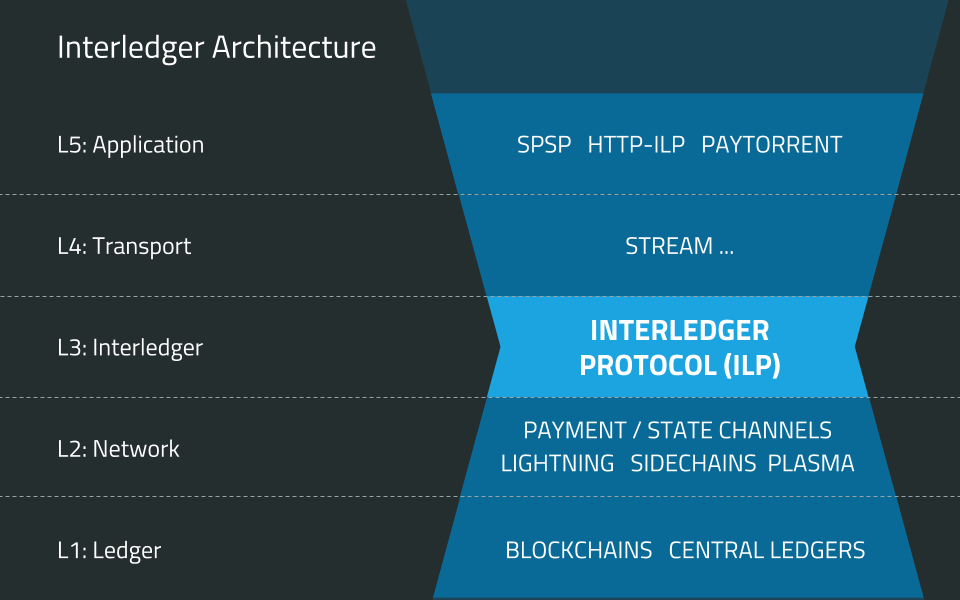
Payment systems historically developed as separate networks.
Bank ledgers did not inherently communicate with digital wallets.
Blockchains did not inherently communicate with banking systems.
Different currencies required different settlement infrastructure.
The Interledger Protocol introduced a powerful conceptual model:
Value should be capable of moving across independent ledgers without requiring those ledgers to become one ledger.
That concept has implications far beyond payments.
Imagine applying similar architectural thinking to private securities.
The objective would not necessarily be one universal private-market exchange.
It could instead be a protocol layer connecting many specialized institutions.
6. From Federated Payments to Federated Private Markets
Payments
Bank → Payment Network → Bank
Digital Value
Ledger → Interoperability Layer → Ledger
Private Markets
ATS → Routing Layer → ATS
Custodian → Ownership Layer → Transfer Agent
Broker-Dealer → Compliance Layer → Marketplace
The important development is not simply digitization.
It is coordination without consolidation.
A security could potentially exist within one ownership infrastructure while being:
- custodied elsewhere,
- discovered through another platform,
- routed to another venue,
- compliance-checked by another provider,
- and settled through another network.
No participant needs to own the entire stack.
7. Federation Does Not Eliminate Competition

This is where federation becomes particularly interesting.
Competition remains essential.
Custodians should compete.
ATSs should compete.
Broker-dealers should compete.
Tokenization platforms should compete.
Settlement providers should compete.
But competition at the application layer does not require fragmentation at the infrastructure layer.
The internet demonstrated this principle remarkably well.
Companies compete aggressively on the internet while relying upon common underlying protocols.
Financial markets may increasingly move toward a similar architecture.
The Institutional Duality
Centralization Federation
Unified control Distributed control
Simplified coordination Coordinated independence
Proprietary ecosystem Shared standards
Vertical integration Specialized participants
Platform dependency Network interoperability
Institutional scale through ownership Institutional scale through connectivity
Neither architecture is inherently superior.
Centralization can create efficiency.
Federation can create resilience.
The institutional challenge is determining where each belongs.
The Apex Perspective
Private markets may not ultimately be dominated by one exchange, one blockchain, one custodian, or one tokenization platform.
Instead, the institutional architecture may become increasingly federated.
Specialized organizations will continue to compete.
But the infrastructure connecting them may become increasingly standardized, programmable, and interoperable.
That changes the strategic question.
The question is no longer:
Who owns the private-market platform?
It becomes:
Who connects the private-market ecosystem?
The next generation of private-market infrastructure may therefore be defined not by consolidation—but by coordination.
Centralization creates platforms.
Federation creates networks.
And networks may ultimately become the infrastructure through which private capital moves.
About The Author
Jonathan S. is Founder, President, Chief Executive Officer, and Chief Investment Officer of Apex Tech Growth Partners. Through the Duality of Private Markets series, he examines the institutional forces shaping the evolution of private capital markets, including liquidity, governance, market structure, tokenization, and programmable market infrastructure.
Related Update