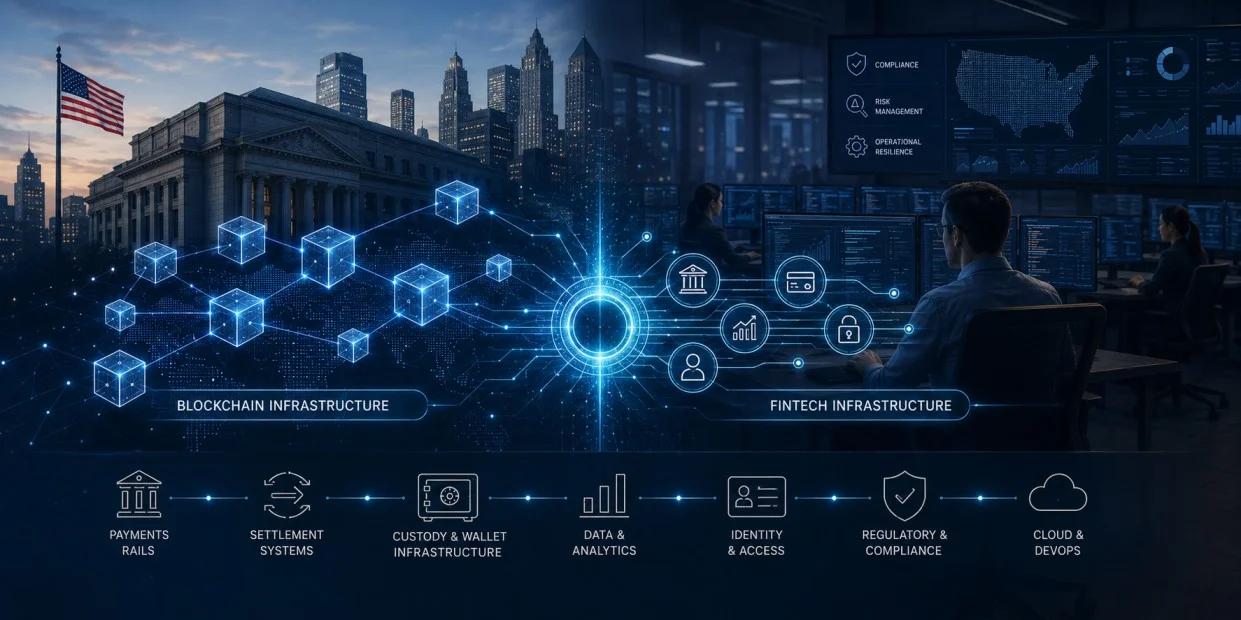


The Duality of Private Markets: Open Architecture vs. Walled Gardens

The Duality of Private Markets: Open Architecture vs. Walled Gardens
The next battle in private-market infrastructure may not be between platforms. It may be between architectures.
Private markets are becoming increasingly digital.
Cap tables are moving online. Securities are being tokenized. Secondary marketplaces are expanding. Custody is becoming programmable. Compliance can increasingly be embedded into infrastructure. Settlement is accelerating.
Yet beneath this transformation sits a more fundamental question:
Will the next generation of private markets be built as interconnected financial infrastructure—or as a collection of increasingly sophisticated walled gardens?
The distinction matters.
A platform can digitize an asset without making that asset portable.
A marketplace can create liquidity without making that liquidity accessible elsewhere.
A blockchain can provide settlement without connecting to another network.
And a tokenized security can become technologically transferable while remaining economically trapped inside the ecosystem where it was created.
This is the emerging duality between Open Architecture and Walled Gardens.
OPEN ARCHITECTURE vs. WALLED GARDENS
Who controls the pathways through which private-market value moves?

The Walled Garden
Walled gardens are not inherently inefficient.
In fact, they can be extremely efficient.
A vertically integrated private-market platform may control:
Origination → Distribution → Compliance → Custody → Trading → Settlement → Recordkeeping
Within that environment, participants operate under common rules.
Identity has already been established.
Compliance procedures are known.
Assets use standardized documentation.
Custody arrangements are integrated.
Settlement occurs within a controlled environment.
The result can be faster execution, lower operational complexity and greater certainty.
For the platform operator, the advantages can be even greater.
The platform controls the customer relationship.
It controls distribution.
It controls data.
It may control liquidity.
And increasingly, it may control the infrastructure through which ownership itself moves.
That is the strength of the walled garden.
It is also its limitation.
Visual 1 - THE WALLED GARDEN
                    PLATFORM
                       │
     ┌─────────────────┼─────────────────┐
     │                 │                 │
  Assets           Investors         Liquidity
     │                 │                 │
  Custody          Compliance        Trading
     │                 │                 │
     └─────────────────┼─────────────────┘
                       │
                   Settlement
A walled garden can optimize activity inside the network while limiting portability beyond it.
When Efficiency Becomes Fragmentation
Now imagine dozens—or eventually hundreds—of these ecosystems.
Each may work exceptionally well internally.
But the market as a whole becomes fragmented.
An investor on Platform A may not be able to access an asset on Platform B.
Liquidity on one venue may be invisible to another.
A tokenized security on Blockchain A may not move easily to Blockchain B.
An institutional custodian may recognize one network but not another.
Investor credentials verified within one ecosystem may need to be established again elsewhere.
The problem is no longer digitization.
The problem becomes connectivity between digitized markets.
This is an important distinction.
Private markets could become technologically advanced while remaining structurally fragmented.
Open Architecture

Open architecture approaches the problem differently.
Rather than requiring every asset, investor, custodian and marketplace to exist inside a single ecosystem, open architecture allows specialized systems to communicate.
One platform may specialize in issuance.
Another may specialize in liquidity.
Another may provide custody.
Another may provide identity.
Another may provide compliance.
Another may provide settlement.
The competitive advantage moves from owning every component to connecting components efficiently.
Conceptually:
Issuer
↓
Digital Asset / Security
↓
Discovery
↓
Eligibility & Compliance
↓
Routing
↓
Multiple Liquidity Venues
↓
Settlement
↓
Authoritative Ownership
The infrastructure coordinates the transaction without requiring every participant to belong to the same vertically integrated platform.
VISUAL 2 - OPEN ARCHITECTURE
Custom Apex diagram:
      Marketplace A        Marketplace B
            \                  /
             \                /
              ROUTING LAYER
             /      │       \
            /       │        \
    Custodian   Compliance   Settlement
         \          │          /
          \         │         /
             ASSET / INVESTOR
                   │
              OWNERSHIP
Open architecture does not eliminate specialized platforms. It allows them to become components of a larger market.
The Marketplace Paradox
This creates an interesting paradox.
The more private-market platforms we build, the more fragmented private markets may become.
Every new marketplace can increase discoverability.
Every new tokenization platform can increase digital representation.
Every new blockchain can increase technical capability.
But if these systems cannot communicate, additional infrastructure can simultaneously create more access points and more fragmentation.
The industry may therefore reach a point where creating another marketplace produces less marginal value than connecting the marketplaces that already exist.
The question changes from:
“Where can this asset trade?”
to:
“How can eligible capital discover and reach liquidity wherever it exists?”
That is an infrastructure problem.
Liquidity Is Not Portable by Default
Liquidity is often discussed as though it belongs to an asset.
It does not.
Liquidity exists within relationships between buyers, sellers, venues, rules, capital and information.
A private security might have interested buyers across five platforms and still appear illiquid on each individual venue.
The liquidity exists.
But it is fragmented.
Open architecture potentially allows the market to aggregate that fragmented interest.
This is where concepts familiar to public markets...such as intelligent routing...become increasingly relevant to private markets.
A future private-market routing system may need to evaluate far more than price.
It could potentially evaluate:
Investor eligibility
Issuer restrictions
Jurisdiction
Transferability
ROFR requirements
Custody
Available liquidity
Counterparty permissions
Settlement infrastructure
Compliance rules
The optimal venue may therefore not simply be where the best price exists.
It may be where the transaction is actually executable.
VISUAL 3 - FRAGMENTED LIQUIDITY
Marketplace A — $5M buyer interest
Marketplace B — $8M buyer interest
Marketplace C — $4M buyer interest
Marketplace D — $6M buyer interest
                     ↓

             ROUTING / DISCOVERY

                     ↓

          $23M ADDRESSABLE LIQUIDITY
Liquidity can exist across the market without being visible from any single venue.
Tokenization Does Not Automatically Create Open Markets
Tokenization is frequently presented as the solution to private-market liquidity.
It can be an important component.
But tokenization solves a different problem.
Tokenization can improve the representation and programmability of ownership.
It does not automatically create:
distribution,
interoperability,
investor eligibility,
liquidity,
legal transferability,
or cross-platform settlement.
A tokenized asset operating inside a closed ecosystem can remain just as economically isolated as a traditional security recorded on a conventional cap table.
The technology may have changed.
The market structure may not have.
This distinction will become increasingly important as financial institutions develop proprietary tokenization environments.
The Institutional Incentive for Walled Gardens
There is also a reason walled gardens persist.
Control has economic value.
Owning the ecosystem can mean controlling:
Customer relationships
Transaction economics
Data
Liquidity
Custody relationships
Distribution
Standards
Access
Opening infrastructure can potentially weaken some of those advantages.
This means interoperability is not purely a technological challenge.
It is also an economic incentive problem.
Institutions may agree that interoperability benefits the broader market while simultaneously benefiting from keeping their own ecosystem closed.
That tension may become one of the defining characteristics of digital financial infrastructure.
VISUAL 4 - CONTROL vs. CONNECTIVITY
WALLED GARDEN
Platform
↓
Customers
↓
Assets
↓
Liquidity
↓
Data
Everything contained within one boundary.
OPEN ARCHITECTURE
Assets ↔ Platforms ↔ Custodians ↔ Investors ↔ Networks ↔ Liquidity
Connected through common standards and interoperability layers.
Closed architecture can maximize platform control. Open architecture can maximize network reach.
Open Does Not Mean Uncontrolled

This distinction is especially important in regulated financial markets.
Open architecture cannot mean unrestricted access.
Private securities still carry eligibility requirements.
Issuers still retain transfer restrictions.
Jurisdictions still impose different rules.
Custodians still have obligations.
AML and KYC requirements remain.
Ownership still requires authoritative recognition.
The objective therefore is not to remove the gates.
It is to make the gates interoperable and programmable.
An institutional architecture might allow verified credentials, transfer restrictions and compliance requirements to move with the transaction without requiring every participant to surrender control to one centralized platform.
This creates a different model:
Open infrastructure. Controlled participation.
Those concepts are not contradictory.
They may ultimately be complementary.
From Platforms to Networks

The first phase of private-market digitization has largely been about building platforms.
The next phase may be about connecting them.
That transition would mirror the evolution of many other forms of infrastructure.
The internet did not become transformative because one company built every website, server and application.
Its power came from common protocols that allowed independently operated systems to communicate.
Financial markets are obviously different.
They require identity, regulation, custody, legal ownership, capital controls and settlement certainty.
But the architectural lesson remains relevant.
The value of a network can increase when independently operated systems can communicate without surrendering their individual functions.
The future of private markets may therefore be neither fully centralized nor completely decentralized.
It may be federated.
Independent institutions.
Independent marketplaces.
Independent custodians.
Independent blockchains.
Independent liquidity pools.
Connected through interoperable infrastructure.
VISUAL 5 - FROM PLATFORMS TO NETWORKS
TODAY
Platform A Platform B Platform C Platform D
Each represented as a separate island.
↓
TOMORROW
Platform A ↔ Platform B
↕ ↕
Custodian ↔ Routing ↔ Marketplace
↕ ↕
Blockchain ↔ Settlement ↔ Transfer Agent
The evolution of private markets may be less about replacing platforms and more about connecting them.
The Infrastructure Layer Between Them
If private markets evolve toward open architecture, something must coordinate communication between otherwise independent systems.
That layer may eventually include:
Identity
↓
Discovery
↓
Programmable Compliance
↓
Routing
↓
Execution
↓
Custody
↓
Settlement
↓
Finality
↓
Authoritative Ownership
This is where interoperability becomes more than the ability to move data between systems.
Financial interoperability requires the ability to move rights, obligations, value and ownership while preserving regulatory and contractual restrictions.
That is a considerably more difficult problem.
It may also be one of the largest infrastructure opportunities in private markets.
The Duality
The debate between open architecture and walled gardens should not be reduced to one being inherently superior.
Each solves a different problem.
Walled gardens optimize the ecosystem.
Open architecture optimizes the network.
Closed environments can provide control, standardization, efficiency and certainty.
Open architectures can provide reach, competition, portability and access to distributed liquidity.
Private markets will likely require elements of both.
The institutional question is therefore not whether every wall should disappear.
It is:
Where should the walls exist and where should there be doors?
Apex Institutional Perspective
The transformation of private markets will not be determined solely by which platforms tokenize the most assets or attract the most users.
The more consequential question may be whether those platforms ultimately become destinations or nodes.
A destination captures activity within its own ecosystem.
A node participates in a larger network.
If private markets remain a collection of isolated destinations, digitization may improve efficiency without fundamentally solving fragmentation.
If those destinations become interconnected nodes, however, private markets begin to develop something they have historically lacked:
networked distribution.
The future infrastructure of private markets may therefore be defined not by a single dominant marketplace, blockchain, custodian or settlement system.
It may be defined by the connective layer between them.
The next generation of private markets may not be won by the platform with the highest walls.
It may be built by the infrastructure that creates the most useful doors.
About the Author
Jonathan S. is Founder, President, Chief Executive Officer, and Chief Investment Officer of Apex Tech Growth Partners. Through the Duality of Private Markets series, he examines the institutional forces shaping the evolution of private capital markets, including liquidity, governance, market structure, tokenization, and programmable market infrastructure.
#PrivateMarkets #MarketInfrastructure #OpenArchitecture #Interoperability #Tokenization #DigitalAssets #SecondaryMarkets #SmartOrderRouting #ProgrammableCompliance #InstitutionalInvesting #FinancialInfrastructure #ApexTechGrowthPartners
Related Update